Word searches for people with dementia: a gentle guide
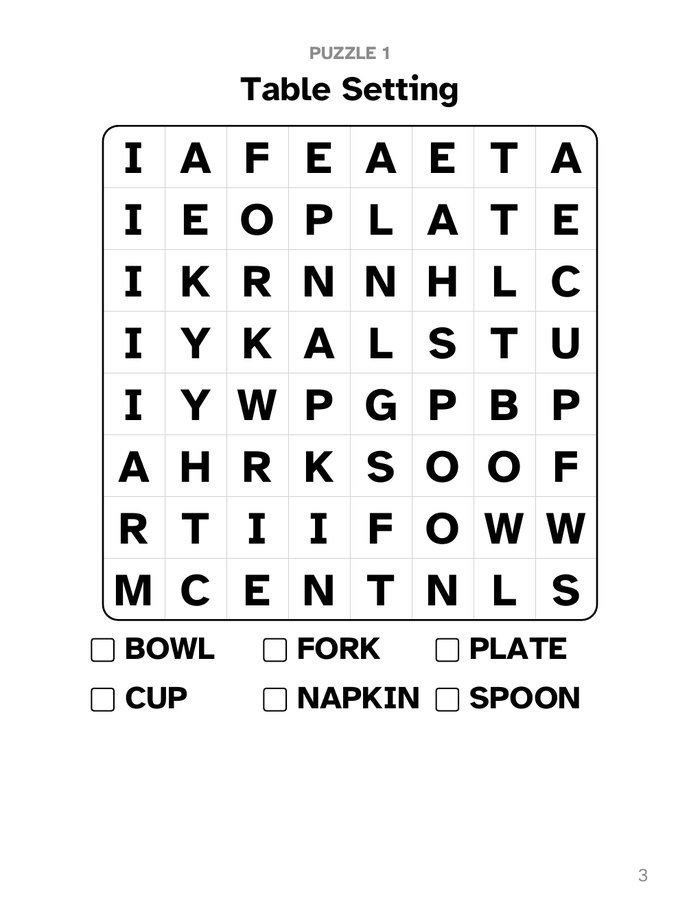
Many people who loved puzzles all their lives still enjoy a word search after a dementia diagnosis. The ordinary ones get hard, though. A busy grid, twenty long words and letters hidden backwards or on the diagonal can turn a favorite pastime into a frustrating one.
This guide is for family members, friends and activity staff. It covers how to pick a puzzle that fits, how to sit with someone while they do it, and what to do when it isn’t working that day. We don’t claim puzzles treat, slow or prevent dementia. The aim is a pleasant half hour and the chance to do something familiar together.
Want to start now? Our free easy large-print word searches have six gentle puzzles: 8 x 8 grids, six everyday words each, letters in 40-point type, words only across and down.
What makes a word search easier
Five things make a word search easier. You can check any puzzle against them before you print it.
- A small grid. An 8 x 8 grid has 64 letters. A standard puzzle often has 225 or more. Fewer letters means less to scan and less to lose track of.
- Few, short words. Six words of three to six letters is a good start. Long word lists are tiring before the first word is found.
- Words that only run across and down. Diagonal and backwards words are the hardest part of a word search for most people. Leave them out completely at first.
- Very large letters. Look for 30-point letters or bigger, with space between them. Print at “actual size” so the printer doesn’t shrink the page.
- Familiar themes. Kitchen things, the garden, a day at the beach. Words people have used all their lives are easier to spot, and the theme gives you something to talk about.
One puzzle to a page also helps. A page with two puzzles, or with adverts and pictures around the grid, gives the eye too much to sort through.
How to help without taking over
- Sit side by side, not across the table, so you see the puzzle the same way up.
- Read the theme and the word list aloud first. “This one is about laying the table: plate, bowl, spoon, fork, cup, napkin.”
- Look for one word at a time. Cover the rest of the list with a card or a finger if it helps.
- Give small hints, not answers. “It starts with a P.” Then “It’s in the top row.” Then point to the first letter. Each step leaves the finding to them.
- Use a thick marker or a highlighter. It’s easier to hold than a pencil, and the found word stands out clearly.
- Let the theme lead to conversation. A word like NAPKIN can bring back a whole Sunday lunch. The talk is often the best part of the activity.
Stopping is fine
There is no need to finish a puzzle. Finding one or two words is a good result, and so is a conversation that drifts off the page. Watch for signs that it has stopped being fun: sighing, pushing the paper away, long silences. Then put it down cheerfully and come back another day, or switch to something with no right answer, like coloring.
Some days a puzzle will be easy and other days the same one will feel hard. That is normal. Keep a few different levels to hand so you can match the day.
Moving up and down the levels
- Easy puzzles go well most days: try 12 x 12 grids with 12 words, still in large print.
- Easy puzzles are sometimes too much: look for two or three words only, and cover the rest of the list.
- Word searches are tiring right now: try coloring pages with thick lines and big spaces.
For the middle step, our free seasonal printables use 12-word puzzles in 30-point print, such as the Thanksgiving word search or the Christmas word search. For a book to keep by the chair, Jumbo Word Search for Seniors has 100 puzzles in the same 30-point letters, one per page, with the solutions at the back. When words are too much, try our free bold, easy coloring pages for seniors.
For care homes and activity groups
- Print a few copies of each level, so everyone gets a puzzle that suits them without being singled out.
- Pair residents up, or pair a resident with a volunteer or a visiting grandchild. Finding words together is more social than finding them alone.
- Read the word list aloud to the whole group and let people call out when they find one.
- Keep sessions short. Twenty to thirty minutes is plenty.
Our free easy puzzles may be printed for any care home, day center or group. Our guides to Thanksgiving activities for seniors and Christmas activities for seniors have more ideas with tips for memory care.
Questions people ask
Are word searches good for people with dementia?
They can be an enjoyable, familiar activity for many people, especially those who did puzzles before. Whether they suit someone depends on the person and the day. Try one easy puzzle together and see how it goes. Puzzles are a pastime, not a treatment.
What level of word search should I start with?
Start easier than you think: a small grid, about six short words, words only across and down, and very large letters. If it goes well, move up. Starting too hard can put someone off for good, and starting too easy does no harm.
What if the person used to be very good at puzzles?
Some people feel a very simple puzzle is childish. Let them choose between two levels, call it a quick warm-up, or do a harder puzzle together as a team. Grown-up themes like gardening, cooking or a sport they followed help too.
Where can I get easy large-print word searches for free?
Our free easy large-print word search PDF has six puzzles with a how-to page and solutions, in US Letter size (it prints on A4 with “Fit to page”). The free printables page has more large-print puzzles and coloring pages.
Get the free printables
Enter your email and a free large-print puzzle pack arrives in a minute or two.