Printable escape room for two people: a guide to playing at home
A printable escape room for two people lets you solve a story together at home, using paper puzzles instead of physical locks. Our Christmas Lighthouse escape room supports 1 to 6 players, so a pair can play with no separate host. This guide shows you how to set out the pages, share the solving, and use hints while keeping the answers a surprise for both of you.
The useful question before printing is how you will check your answers. If one person has to read every solution beforehand, that person loses the chance to discover the puzzles. In our game, the code sheet lets players test their own codes. Both of you can stay on the same side of the mystery.
What a paper escape room asks you to do
In The Christmas Lighthouse, snow has stopped the ferry, and Grandpa is on it. The Christmas Lamp needs to shine to guide the ferry home. Its key is in his sea chest, behind seven puzzle locks he made for his grandchildren.
Each lock is a puzzle on a page. Solving it gives you a code to record and check. You need no padlocks or boxes, and the harbor chart needs no real compass: everything needed to solve the puzzles is on the pages.
For two players, keep the code sheet where you can both see it. Treat it as your shared record, rather than letting one person become the referee. When you think you have an answer, explain how you reached it before checking. That gives your partner a chance to spot a missed instruction and follow the discovery.
You can see our printable escape rooms for the broader collection. Here, we will use the Christmas game to show what playing as a pair looks like.
Look at the lock pages before you choose roles
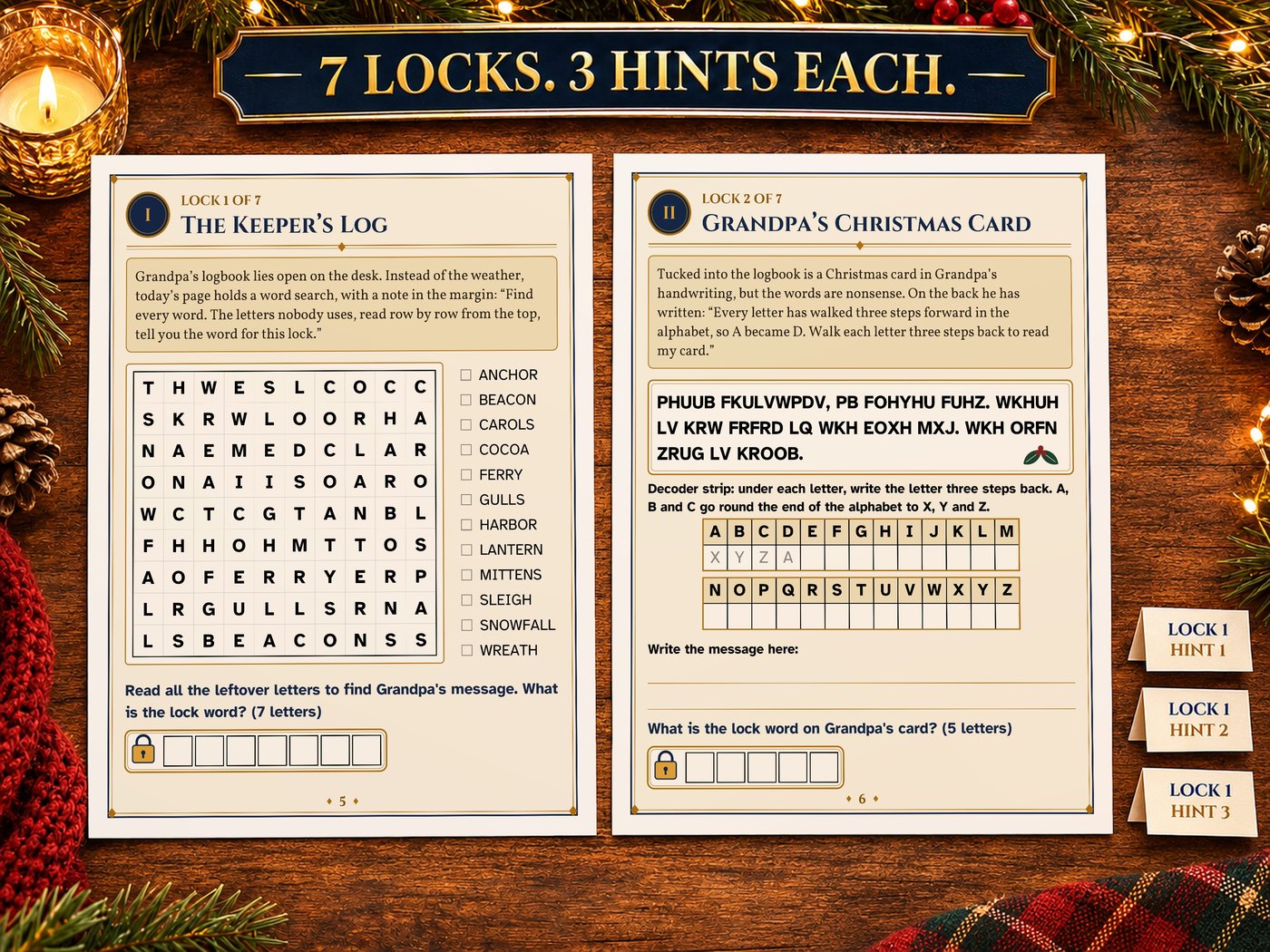
The picture shows Lock 1, The Keeper’s Log, and Lock 2, Grandpa’s Christmas Card, with three folded hint strips for Lock 1 beside them. The log page contains a word search with a hidden message. The card page contains a coded message and a decoder strip. These are the real lock pages shown in our product image.
They suggest different ways to share the work. On the word search, you might take turns finding words, then read the remaining letters together. On the card, one person can work through the decoder while the other writes the message. Swap jobs if the writing starts to feel like the whole task.
Try reading each page aloud before either of you picks up a pencil. It puts the instructions in front of both players and makes it easier to notice the step after the obvious task. Finding the words, for example, is only part of a hidden-message puzzle.
Set up so neither player sees the solutions
You need a printer and paper, pencils, and scissors for the hint strips. Envelopes are optional. The download includes US Letter and A4 versions, with color and low-ink editions, so choose the paper size and game version you want before printing.
The game is 15 pages, including the story, setup notes for the grown-up, a code sheet, seven lock pages, hint strips, and a sealed ending. The separate solutions file is eight pages. Keep that file closed while you arrange the game; its first page contains all seven codes.
Follow the setup notes, and keep the ending aside until you reach it. Put the hint strips where you can reach them without spreading them face up. If you use envelopes, label them clearly so looking for a hint does not turn into searching through answers.
Sit where you can both read the page comfortably. Leave room for the code sheet and your working notes. If one player has to crane around the other to see every clue, move the paper before you start solving.
Share each lock before splitting the work
Start by working on the same lock together. One person can read the instruction while the other points to the relevant part of the page. Then decide who wants to try the first step.
Splitting the locks can mean taking turns leading them. After one player leads a puzzle, pass the next page to the other. The partner can check the reasoning or keep notes, but should still have room to suggest an approach. Avoid assigning all the puzzles in advance by who seems more experienced.
If you decide to work on different available pages, read their instructions first and follow any connections between locks. Come back together before recording an answer. Show the work, including any uncertainty, rather than announcing a finished code and moving on.
When someone gets stuck, exchange pages or roles before reaching for a hint. A fresh reader may notice an instruction the first player skimmed. If one of you finishes a step quickly, let the other finish reading before explaining it. There is room to enjoy an idea before the answer arrives.
Choose a pace you both want
The story gives players 90 minutes, and the timer is optional. That is the story’s time limit, not a promise that every pair will finish in that time. Decide together if you want to use it before beginning.
For a relaxed evening, leave the timer off and move on when you are ready. If you want the countdown, agree that either player can ask for a pause. Keep the conversation about the puzzle rather than how much time the other person is taking.
Before checking a code, trace it back to the page. Have you followed the instruction all the way through? Has anything been copied incorrectly? If the check does not work, compare your working with the original clue before changing the answer at random.
Use a hint while you still want to solve
Every lock has three progressive hints, from a nudge to the final step. Agree that either player can suggest using one. Read the first hint for the lock you are on, then return to the page and try its suggestion before opening another.
There is no need to stay silent over a puzzle that has stopped moving. Say which part you understand and where the reasoning breaks down. That helps you use the hint as a next step, rather than reading it and immediately reaching for the next strip.
If you need the solution, the separate file explains each puzzle step by step, one lock per page after the opening answer key. Go to the relevant lock without reading the all-code page. You can then understand that puzzle and keep the remaining answers unseen.
If you would like to make some puzzles yourself
For homemade puzzle ideas and ways to use envelopes, our guide to a Christmas escape room at home walks through the setup. If you make a game for your partner, decide beforehand who will know the answers. Writing a puzzle yourself changes your role from fellow solver to its host.
With a ready-made game, you can both approach the pages without knowing their solutions. Keep the answer file separate, and let the printed checks and hints do their jobs.
Planning a date night for two grown-ups rather than a family evening? Our Valentine’s Murder Mystery for Two is written for exactly two players: each of you holds your own file, and you solve the case by comparing them across the table.
How we made and tested this
We made The Christmas Lighthouse as a printable story with seven puzzle locks. The puzzles and text were made with AI help and checked by the studio. Our recorded checks include machine checks for wrong-code collisions, a review of all 23 US Letter color game and solution pages, and a blind solve of all seven locks without hints.
The Christmas Lighthouse is our printable Christmas escape room for 1 to 6 players, ages 10+, with hint strips and separate solutions.
Get the free printables
Enter your email and a free large-print puzzle pack arrives in a minute or two.