DIY Christmas escape room at home: a family guide
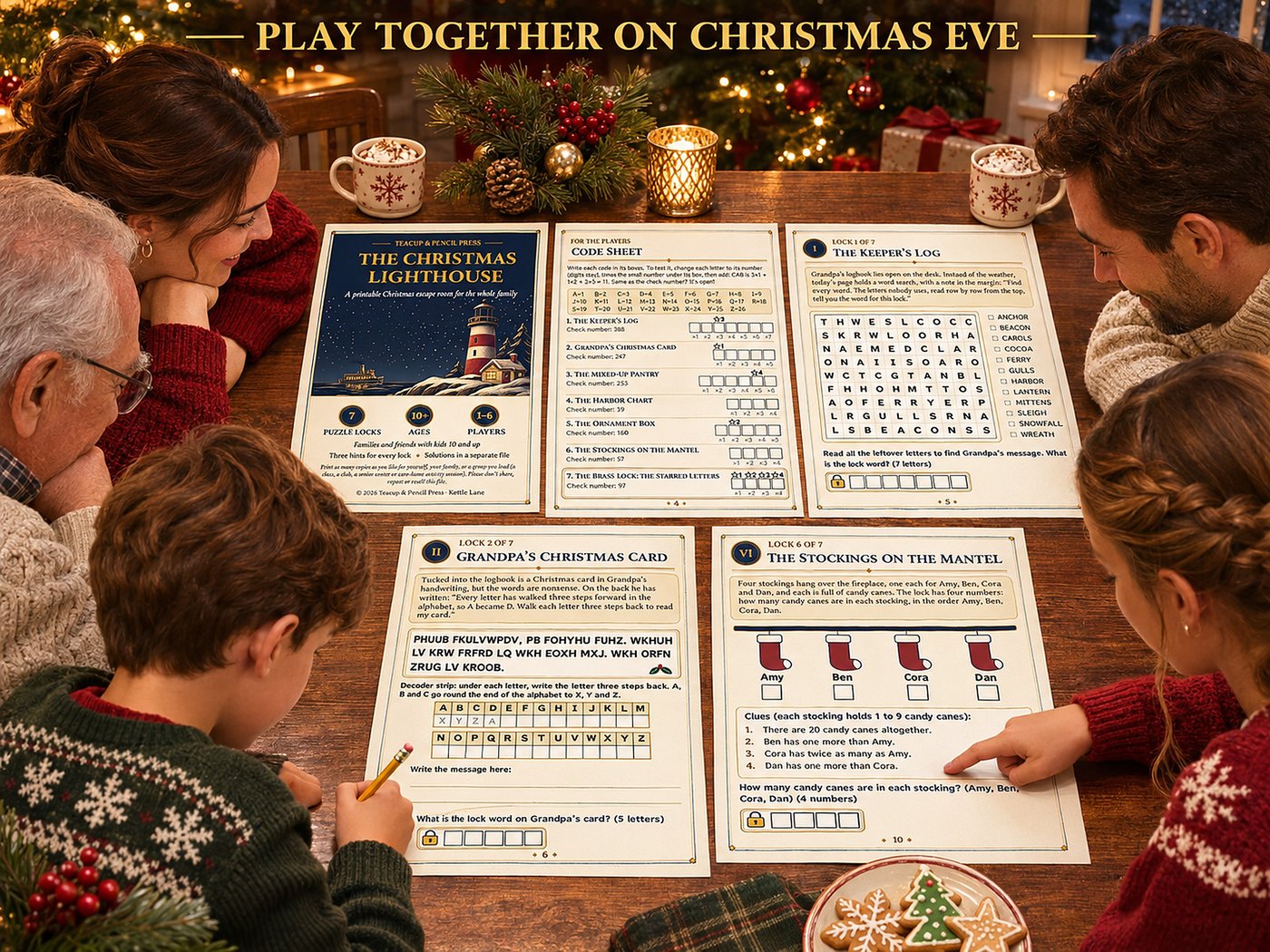
An escape room at home is a story with a lock at the end of every puzzle: solve the puzzle, get the code, open the next envelope. At Christmas it turns the family into one team, with grandparents reading clues and kids racing to crack codes, and it works with nothing more than paper, pencils and a few envelopes.
This guide shows how to make your own in an evening: a story, five puzzle types anyone can build, how to “lock” them without real padlocks, and how to keep it fun for an 8-year-old and an 80-year-old at the same table. If you’d rather print one that’s ready to play, there’s one at the end.
1. Start with a small story and a deadline
Every good escape room has a reason to hurry. Keep it short and cozy:
- Santa’s sleigh map is locked in the workshop safe, and he leaves at midnight.
- The Christmas cookies are locked in the pantry, and the guests arrive in an hour.
- Grandpa hid the last present behind five puzzles, and he’ll only hand it over when they’re solved.
Write it on a card, read it aloud, and set a kitchen timer if your family likes a race. For younger kids, skip the timer: the story is the fun part.
2. Five paper puzzles you can make tonight
Each puzzle hands out one code. Write every code down on a sheet before you start, so you can check answers quickly.
A word search with a hidden message
Make a word search of Christmas words on squared paper. Fill the empty squares with the letters of a secret word, in order, row by row. When players have found every word, the leftover letters spell the code word. Big squares and short words keep it friendly for young readers and older eyes.
A secret-code Christmas card
Write a short message in a simple code: shift every letter one place along the alphabet (A becomes B, B becomes C). “STAR” becomes “TUBS”. Put the alphabet at the bottom of the card as a decoder, and the message tells players where to look next or gives them the code.
Counting in plain sight
Hide the numbers of a 3-digit code in the room: the number of candles on the mantel, the number of stockings, the number of baubles of one color on the tree. A card says “Candles, stockings, gold baubles”, and players count their way to the code.
Riddles on ornaments
Hang three paper ornaments, each with a riddle whose answer is a Christmas word. The first letters of the answers spell the next code. Keep the riddles short, and read them aloud for anyone who finds small print hard.
A map with a compass
Draw a simple map of the room or the house with a compass rose. A card gives directions: “Start at the door. Three steps north, two steps east.” Where players stop is where the last envelope is hidden.
3. “Locks” without padlocks
You don’t need boxes or padlocks. Put each next puzzle in an envelope with a number on the front, and the rule is simple: you may open envelope 3 only when you say the code from puzzle 2. The host checks the code against the answer sheet. Older kids can play without a host if you give them a code sheet that lets them check their own answers.
4. Hints keep everyone happy
Write two or three hints for every puzzle on folded slips, from a small nudge to the last step. Agree on a rule, such as one hint every five minutes, so nobody gets stuck long enough to give up. A family escape room should end with a cheer, not a sulk.
5. Mixed ages: who does what
- Kids love the counting, the map and running to find envelopes.
- Grandparents are often the best riddle-solvers and code-crackers, and the natural readers of the story.
- Teens like being in charge of the code sheet and the timer.
- Play as one team rather than competing: an escape room works best when everyone needs everyone.
For more ideas for the whole family, see our easy Christmas games for seniors, which work just as well with grandchildren at the table.
Questions
How many people can play a home escape room?
Two to six on one team works best. For a bigger group, make or print one set per team and race.
What age is a Christmas escape room for?
Homemade puzzles can suit any age: make them easier with picture riddles and counting, or harder with codes. Ready-made printable escape rooms usually say their age; ours is for ages 10 and up, and younger kids enjoy it on a team with a grown-up.
Do I need padlocks or boxes?
No. Numbered envelopes and an answer sheet do the same job, and nothing gets broken.
Rather print one that’s ready to play?
Making puzzles is fun, but it takes an evening. The Christmas Lighthouse is our ready-made Christmas escape room: snow has stopped the ferry, Grandpa is on it, and seven puzzle locks stand between your family and the Christmas Lamp. It has a set-up page for the grown-up, three hints for every lock, a code sheet so players can check their own codes, and every solution explained in a separate file.
- The Christmas Lighthouse, printable escape room: print at home, 1 to 6 players or teams for a bigger group, ages 10+, everything on the pages (no padlocks or boxes), with a low-ink edition, US Letter and A4.
- The Christmas Lighthouse, browser edition: the same game played on a computer or laptop and shown on the TV, with an optional 90-minute timer. No app, no account, it works offline, and the printable edition is included. (It plays in Chrome, Edge or Firefox, or Safari on a Mac; not on phones or tablets.)
More free Christmas puzzles to print, including a word scramble and cryptograms, are in our free Christmas printables.
Get the free printables
Enter your email and a free large-print puzzle pack arrives in a minute or two.