Christmas trivia for seniors: 28 questions with answers
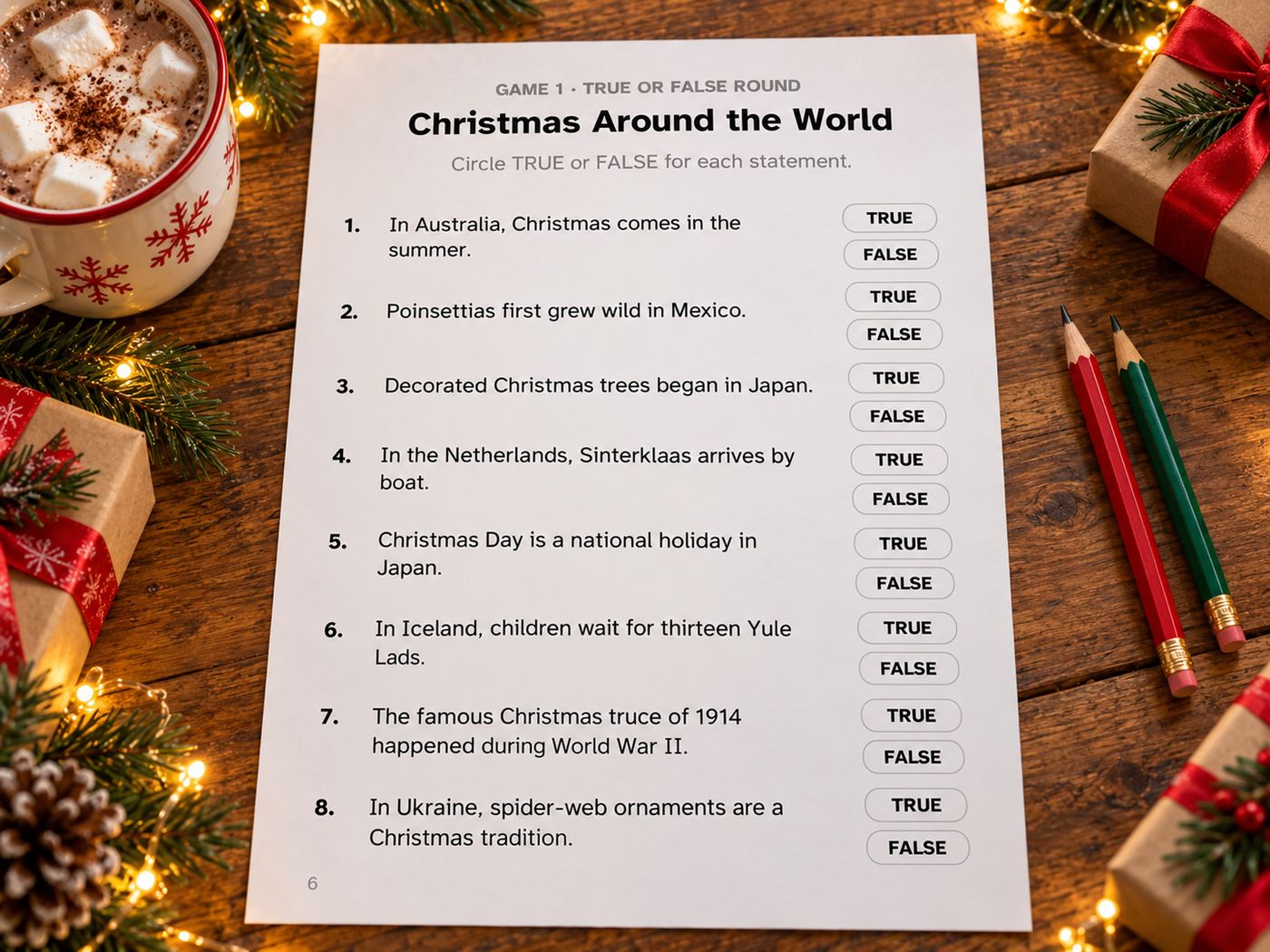
Good Christmas trivia for seniors is easy to hear, quick to answer and fun to get wrong. That is why every question below is true or false or which came first?: nobody has to pull an answer out of thin air, and every answer comes with a one-line explanation that often starts a story at the table.
There are 28 questions in four rounds, enough for a 45-minute trivia hour at home, in a senior center or in a care-home activity room. Read them out loud, or print them big.
How to run Christmas trivia for older adults
- Play in teams of two to four. Nobody is put on the spot, and a partner can help anyone who doesn’t hear or see well.
- Read each question twice, slowly, and give everyone a card or a hand signal for TRUE and FALSE.
- Read the explanation after every answer. It is the part people remember and talk about.
- Keep score loosely. One point per right answer, and a candy cane for the winning team is plenty.
- Stop while it’s still fun. Two rounds and a cup of cocoa beat four rounds and tired faces.
Round 1: Christmas around the world (true or false)
- In Mexico, Las Posadas is celebrated over the nine nights before Christmas. True. It runs from December 16 to 24, with a procession and a party each night.
- In Sweden, St. Lucia’s Day is celebrated in the middle of summer. False. It is December 13, one of the darkest days of the Swedish winter: a festival of light.
- Germany’s famous Christmas markets traditionally open in July. False. They open during Advent, in late November or early December.
- The Christmas season in the Philippines is one of the shortest in the world. False. It is one of the longest: carols and decorations start in September and the season lasts into January.
- In Italy, La Befana is a reindeer who brings gifts on January 6. False. La Befana is a kind old woman on a broomstick who brings gifts on the night before January 6.
- In Ethiopia, Christmas is celebrated on January 7. True. Ethiopia follows its own calendar, and Christmas, called Genna, falls on January 7.
- In Canada, letters to Santa can be sent to the postal code H0H 0H0. True. Canada’s postal service gave Santa that code, and volunteers answer the letters every year.
- In Poland, Christmas Eve dinner traditionally begins when the first star appears in the sky. True. Families watch for the first star before sitting down to the Christmas Eve meal, Wigilia.
Round 2: Christmas at home (true or false)
- Poinsettias first grew wild in Mexico. True. They are named after Joel Poinsett, the first U.S. minister to Mexico, who brought them to the U.S. in the 1820s.
- Mistletoe grows on other trees. True. It grows on the branches of trees such as apple and oak and draws water from them.
- Some of the first artificial Christmas trees were made from dyed goose feathers. True. Feather trees were made in Germany in the 1800s.
- Electric lights were used on Christmas trees before candles. False. Candles came first; the first electric tree lights were shown in 1882.
- Holly berries are safe to eat. False. Holly berries can make people and pets sick.
- Snowflakes grow with six arms or sides. True. Ice crystals grow in a six-sided pattern.
Round 3: Winter facts (true or false)
- Polar bears have black skin under their white fur. True. The black skin soaks up warmth from the sun; the fur looks white, but each hair is clear.
- Wild penguins live at the North Pole. False. Wild penguins live only in the Southern Hemisphere (a few reach the equator); none live in the Arctic.
- Antarctica is the largest desert in the world. True. A desert is a place with very little rain or snow, and Antarctica gets so little that it is the largest.
- The coldest temperature ever measured on Earth was recorded in Siberia. False. It was recorded in Antarctica, at Vostok Station in 1983: about -128 degrees Fahrenheit.
- In the United States, Groundhog Day is on February 2. True. Every February 2 a groundhog “predicts” whether winter will last six more weeks.
- Arctic foxes keep their white coats all year round. False. Their coats turn brown or gray in summer and white again in winter.
- Emperor penguin fathers keep the egg warm on their feet through the Antarctic winter. True. The father balances the egg on his feet under a fold of skin for about two months.
- A blizzard is a light snowfall with no wind. False. A blizzard is a snowstorm with strong winds and very poor visibility for hours.
Round 4: Which came first?
Read both, and teams pick the one that happened first. Older players often do very well here.
- “A Visit from St. Nicholas” (“’Twas the night before Christmas”), or Charles Dickens’s A Christmas Carol? The poem, first printed in 1823; A Christmas Carol came in 1843.
- The Statue of Liberty, or the first National Christmas Tree lighting in Washington? The Statue of Liberty, dedicated in 1886; the National Christmas Tree was first lit in 1923.
- The Nutcracker ballet, or the Eiffel Tower? The Eiffel Tower, opened in 1889; The Nutcracker was first performed in 1892.
- Christmas becoming a U.S. federal holiday, or Lincoln proclaiming a national Thanksgiving Day? Lincoln’s proclamation, in 1863; Christmas became a federal holiday in 1870.
- “Silent Night” first sung, or a steamship crossing the Atlantic for the first time? “Silent Night,” first sung in Austria on Christmas Eve 1818; the steamship Savannah crossed in 1819.
- The first Christmas tree inside the White House, or electric Christmas tree lights? Electric tree lights, shown in 1882; the first indoor White House tree is usually dated to 1889.
For memory care: questions with no wrong answers
For a group living with memory loss, swap the quiz for questions that invite a story and can’t be answered wrongly:
- What was in your stocking when you were a child?
- Who made the best Christmas dinner in your family, and what did they make?
- Did your family have a real tree or an artificial one?
- What is the first Christmas present you remember?
- Which Christmas song do you like best?
Give a point for every story, and let the conversation run. Our guide to Christmas activities for seniors has more ideas for memory care, and our guide to word searches for people with dementia explains how to choose an easy puzzle.
Tips for low vision and hearing
- Print the questions in large type (at least 24-point) if people will read along.
- Use a microphone in a big room, and face the group when you read.
- Hold up a big TRUE and FALSE card after each question so nobody has to guess what was said.
Questions
How many trivia questions do I need for an hour?
About 25 to 30, with a short story or chat after the answers. Two rounds of eight make a good half hour.
Are true or false questions too easy for seniors?
Not when the facts are surprising. Expect a lively debate about the polar bear’s skin and the coldest place on Earth. For a harder round, use “which came first?”, where dates matter.
Can I print these questions?
Yes, for your own family or a group you lead. If you’d like the trivia rounds ready to print in large type, with a score sheet and more games, see below.
Make it a whole game night
These questions are a taste of the trivia in our printable games. For a full Christmas evening, our Christmas Family Game Night has ten large-print games, from true or false rounds and which came first to word search and scramble races, with a host page, a score sheet and every answer at the back. For more games with simple rules, see our easy Christmas games for seniors, and for something quiet to hand out afterwards, our free Christmas printables include a large-print word search, a word scramble and cryptograms.
Get the free printables
Enter your email and a free large-print puzzle pack arrives in a minute or two.